ChatGPT doesn't know about Gemini. But it can spawn it with a hyperlink
In a past post I explored how AI generates its own internal navigation - expandable links that turn responses into explorable knowledge trees. But those links stayed within one system. What if they didn't? What if clicking a term in ChatGPT could hand you off to Gemini? It can — though "context intact" turns out to be the wrong way to describe what survives the trip.
What This Looks Like#
You're chatting with ChatGPT about quantum computing. It gives you a solid explanation, but you want more depth on qubits specifically. Instead of opening a new tab, copying your question, and switching contexts, you click a link ChatGPT embedded in its response.
Google opens with search results - and often, at the top, before the blue links, there's an AI Overview. Gemini has already generated a response to your query. No manual prompt entry, no clicking "Ask AI," just an immediate AI-generated answer.
"Often" is doing real work in that sentence. Google decides which queries get an AI Overview, and a linker can't force one. Expect a meaningful share of clicks to land on ordinary search results.
The workflow feels continuous. You're orchestrating multiple AIs through hyperlinks, but it doesn't feel like orchestration - it feels like following your curiosity. ChatGPT just became a navigation system for AI specialization.
Let's make this concrete. You ask ChatGPT: "Can you ELI8 future science?"
ChatGPT responds with its explanation - qubits are like magical coins that can be both heads and tails until you look at them, quantum computers use this to try many solutions at once - and includes links at the end:
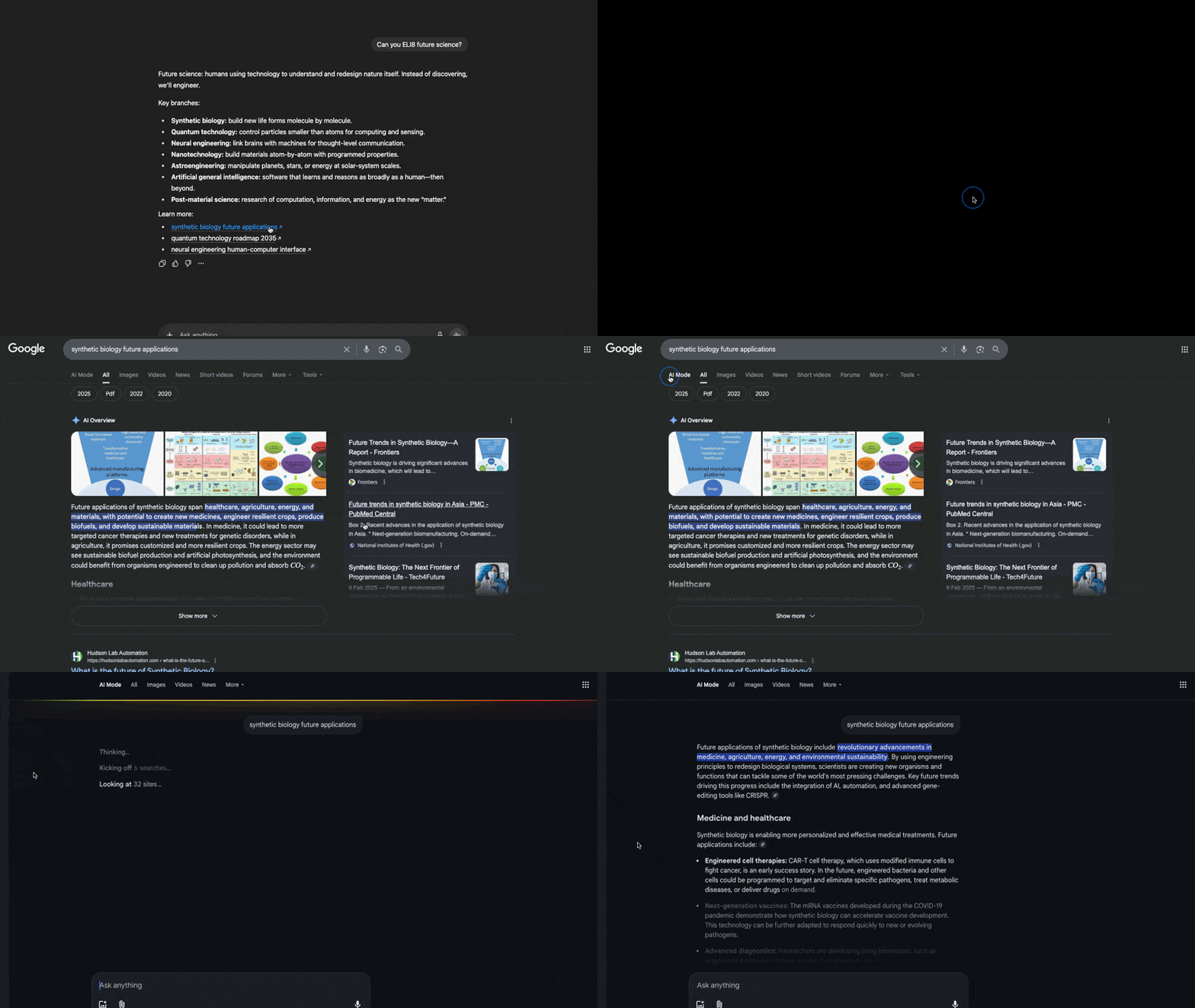
You're not managing two conversations - you're following a thread of curiosity across two AI systems, orchestrated through URLs.
How It Works#
The mechanism is simple. You give ChatGPT custom instructions that change how it formats responses:
When answering questions, include relevant Google search links for concepts worth exploring further.

Format links as: [concept or topic](https://www.google.com/search?q=detailed+search+query)

Make search queries specific and well-formed - they will be used directly by AI.

Include 2-3 "Learn more" links at the end of each response.

Focus links on: technical deep-dives, alternative perspectives, or practical applications.
Now every ChatGPT response includes clickable search links. When you click one, Google opens with that query, and when an AI Overview fires, Gemini has already answered it.
What makes this work is that https://www.google.com/search?q=your+query can return more than blue links: for queries Google judges suitable, it generates a summary at the top of the page from the query string. ChatGPT is effectively pre-filling Gemini's input, all through a hyperlink.
Worth being precise about what does and doesn't travel. The only thing crossing the boundary is the search string ChatGPT wrote. Your conversation history, your earlier questions, the framing that made the answer useful — none of it goes with you. ChatGPT compresses whatever context it has into a query, and that query is the entire handoff.
Three things align to make this possible:
Google's AI Overview feature treats search queries as prompts. Not designed as an API endpoint, but functions like one.
URL parameter encoding carries the handoff. ChatGPT encodes a concept into a search query; that query becomes Gemini's prompt via AI Overview. It's a lossy channel — one string, no history — but it needs no coordination between the two systems.
You as orchestrator decide which links to follow, when to bounce between AIs, when to stop. The delegation is one-way (ChatGPT → Gemini), but you provide the return path manually.
What I Learned#
Three things surprised me while exploring this pattern.
First, URLs are the oldest interoperability protocol we have - and they still work better than most API integrations. Hyperlinks don't require authentication, version negotiation, or schema coordination. They just work. ChatGPT doesn't need to know Gemini exists. Google doesn't need to know ChatGPT is delegating queries. The web's original linking mechanism handles cross-system orchestration without anyone planning for it.
Second, stateless delegation is more powerful than I expected. Each AI starts fresh with the pre-filled prompt. There's no conversation threading, no shared memory, no "return to ChatGPT with context" link. You might think that's a limitation - and for some workflows, it is. But for exploration, it's a feature. You're not building a complex state machine. You're following curiosity, one click at a time. The simplicity makes the pattern discoverable.
Third, this approach avoids context pollution in a way ChatGPT's built-in features don't. ChatGPT lets you highlight text and add it to the input textarea - convenient, but it dirties your conversation context. Every highlighted snippet becomes part of the conversation history, cluttering the thread with fragments you just wanted to explore briefly. The URL delegation pattern keeps contexts separate: your ChatGPT conversation stays clean, while Gemini handles the deep dive. When you're done exploring, you come back to an unpolluted thread.
The state problem does matter for bidirectional workflows. If you want ChatGPT → Claude → back to ChatGPT with full context, you'd need conversation threading support that doesn't exist yet. For now, this works best as one-way delegation: use the right AI for the task, then manually integrate results back into your main conversation.
Chat Interfaces as Switchboards#
AI-generated navigation started with internal links - making responses explorable within a single system. But URLs don't stop at system boundaries. When AI can generate links that spawn other AIs, chat interfaces start feeling less like messaging apps and more like switchboards.
This pattern is simple enough that it feels obvious in hindsight. But that's the point. The most interesting capabilities often hide in the gap between "what's technically possible" and "what interfaces suggest we should do." We've been treating AI systems as isolated conversational partners when they could be collaborative networks connected through the oldest hypertext protocol we have.
As AI systems proliferate and specialize, orchestration through URLs might become more common than orchestration through code — not because anyone planned it that way, but because it needs no coordination between the systems involved.